
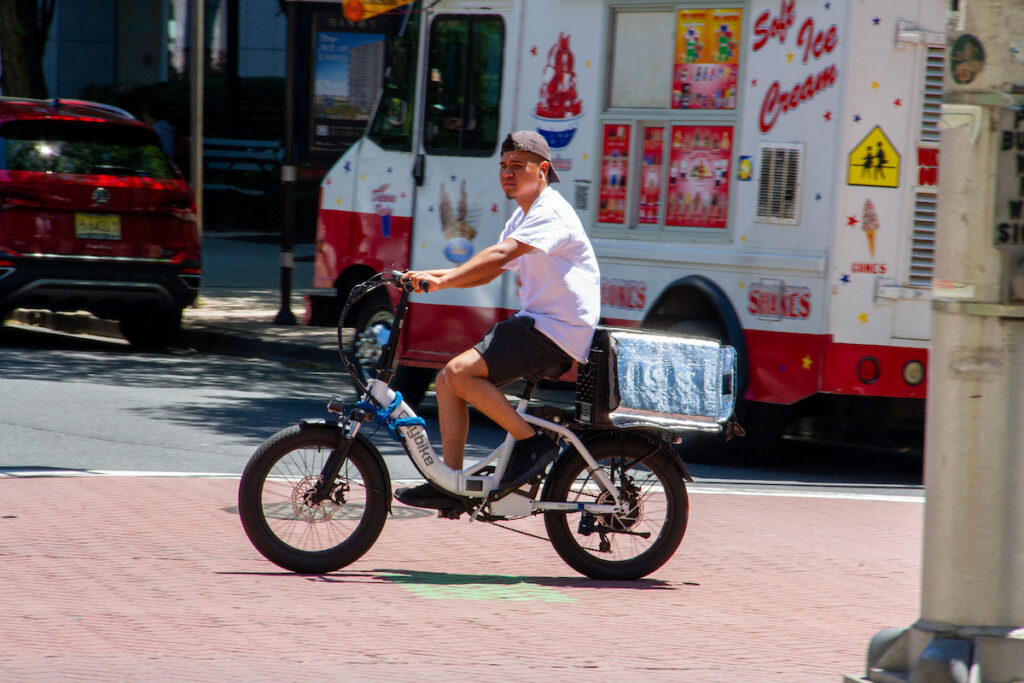
Electric bicycles have proliferated across the country in recent years, and New Jersey has been no exception. E-bikes provide a cleaner and less expensive alternative to motor vehicles but enforcement has become tricky with so many different types of e-bikes on the road, all sharing space with cars, pedestrians, and traditional bicycles.
New Jersey passed a new law in January that requires e-bikes to be registered and riders to have liability insurance, among other changes. The legislation allows for a six-month grace period with full enforcement scheduled to begin on July 20 and all fees waived until January 19, 2027.
 The previous three-tier e-bike classification has been eliminated. Class 1 and Class 2 e-bikes that can travel up to 20 miles per hour (MPH) and Class 3 e-bikes that travel up to 28 MPH will require a valid New Jersey driver’s license or motorized bicycle licenses.
A helmet will be mandatory for all e-bike riders regardless of age. In addition, for those 17 years old and older, a basic driver’s license will now be required. For 15- and 16-year-olds, they must obtain a motorized bicycle license from the New Jersey Motor Vehicle Commission (NJ MVC). Children younger than 15 years old are prohibited from operating e-bikes.
Online sales of electric motorized bicycles are banned for one year and modification kits can increase an e-bike’s speed are now prohibited, according to the new legislation.
What has made enforcement especially hard for local police departments is the different classes of e-bikes. It can be difficult for law enforcement, or really anyone, to differentiate the type of e-bike just by looking at one. Some have been modified by users to eliminate the restriction on speed entirely, allowing them to go faster than 28 MPH. There also is confusion among the public about the difference between e-bikes and mopeds.
In January 2026, Governor Philip Murphy signed S4834/A6235 that requires licensure and registration for both “low-speed electric bicycles” and “motorized bicycles.” The new law states that e-bike riders have until July 19 to obtain the appropriate license and registration through the NJ MVC to comply with the law. NJ MVC procedures for licensing and registration are still under development. In 2024, at least 14 people riding these types of devices were killed in crashes involving other motor vehicles. The new law also provides for better reporting of these crashes, something that other states, like California, have also tried to improve.
New Jersey will now require insurance
To obtain e-bike registration, the NJ MVC recommends obtaining e-bike insurance and scheduling a registration appointment. Owners would have to provide identification and show a valid proof of ownership or affidavit of ownership along with a Manufacturer’s Certificate of Origin (MCO). If an MCO, bill of sale or formal proof of ownership is not available, the NJ MVC may accept an affidavit from the current owner. The affidavit sets forth “with reasonable specificity the acquisition of ownership of the e-bike, together with any supporting documents,” as proof of ownership of the e-bike. The MVC has clarified that low-speed electric bicycles don’t require insurance but still must be registered.
The MVC considers a motorized bicycle, or moped, a pedal bicycle that is throttle-capable of assisted speeds up to 28 MPH. A low-speed e-bike is a two-wheeled bicycle with pedals where a motor assists the rider only when pedaling and ceases to provide assistance once the bicycle reaches the speed of 20 MPH.
Follow the Events calendar on Street Smart NJ and our Transportation Management Association (TMA) partners for opportunities to learn more about e-bikes and the new state law. RideWise will partner with the Hillsborough Police Department for a free informational webinar on April 15 about “E-Bike Safety 101: E-Bike Essentials.”
Other resources and materials
- The New Jersey State Policy Lab at Rutgers University recently offered some perspectives on the new e-bike law.
- The New Jersey Bike & Walk Coalition took part in a December webinar about what model policy should look like for e-bikes.