

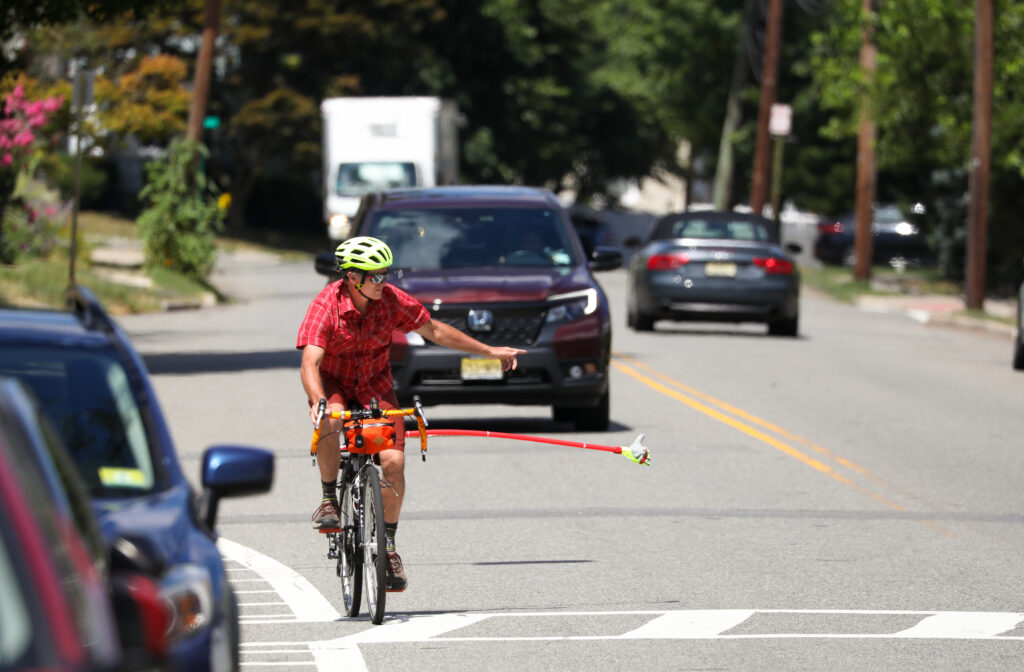
Do you know about New Jersey’s Safe Passing Law (NJSPL)? It’s not really new anymore. In fact, as of March 1, it’s been four years since it went into effect.
Four years can be a long time but at the same time, it can feel like it passes pretty quickly. It’s the typical length of one’s time in high school, and in most cases, about the same length as one’s undergraduate college experience. Think about where you were and what life was like four years ago: A little different but not quite that different, right?
The Safe Passing Law has been around four years but it never hurts to remind the public about it because people still might not be aware of it. And even if you do know about the law, a refresher can always be helpful. Have you found yourself driving somewhere and passed a pedestrian or runner and remembered to give them 4 feet of space or slowed down? Well, you should have.
The law (A5570/S2208), passed in the summer of 2021, provides clear rules of the road for all motorists about when and how to pass people sharing the road on foot, on bicycles, on scooters, wheelchairs or in other legally permitted ways to travel other than a motor vehicle.
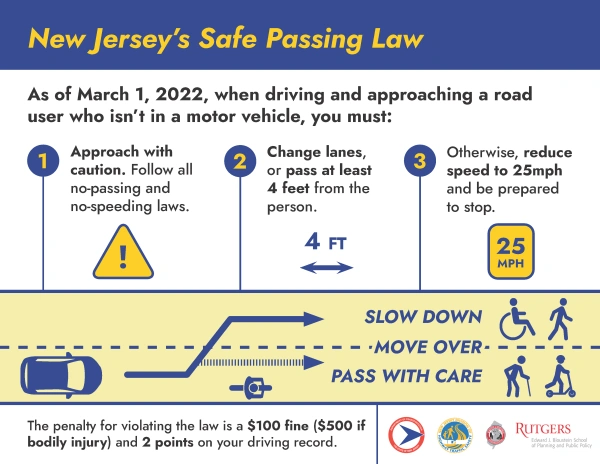
What is New Jersey’s Safe Passing Law?
Drivers are required to use “due caution” whenever they see vulnerable people on the road. The law states that:
- Drivers must follow all current no-passing, no speeding laws AND move over a lane if there’s one to move into.
- On a single-lane road, drivers must allow at least a 4-foot safety zone when they pass.
- If 4 feet is not possible on a section of road, drivers must slow to 25 MPH — and be prepared to stop — until they can pass safely without endangering those sharing the road.
Drivers who violate the Safe Passing Law, and cause bodily injury, are subject to a $500 fine and two motor vehicle penalty points. Even if there is no bodily injury, drivers face a fine of $100.
Driving in a vehicle can insulate you from what it might be like on the outside. Driving 25 MPH might seem like a snail’s pace behind the wheel but if you’re walking or on a bicycle or scooter, a vehicle going faster than 25 MPH that passes you within 4 feet feels a whole lot different from that perspective. Now imagine that vehicle going 30 or 40 MPH.
When the law took effect in 2022, New Jersey had been coming off one of the deadliest years on the road in recent memory. There were 667 fatal crashes in 2021, including 697 fatalities, according to data compiled by the State Police. Among those fatalities were 217 pedestrians and 26 cyclists.
Since then, the numbers have fluctuated overall, with some promising declines in fatalities, dropping to 606 in 2023 but a terrifying resurgence to 684 in 2024 before another decrease last year to 578. Pedestrian deaths likewise fluctuated, dropping from 217 to 191 in 2022 and then again to 171 in 2023 before another spike to 230 in 2024 when they accounted for more than 33 percent of fatalities, up from 27 percent in 2022.
This year has started out with some encouraging numbers compared to previous years, down about 10 percent but if these data show anything, it’s that the job is never done. Persistence is vitally important in keeping people safe and pedestrian and roadway safety is really something that takes diligence and never letting up. That includes continuing to educate all road users, whether that’s drivers, pedestrians, or people on bicycles, and reminding people of the Safe Passing Law as well as things they can do to keep their fellow neighbors safe.